CORTEX

Connectome

The wiring diagram of your whole business.

Neuroscientists call the complete wiring diagram of a brain its connectome: every neuron, and every connection between them. In 2024 they finished one for the brain of an adult fruit fly. CORTEX draws the same kind of map of a business, and borrows the fly's layout to do it.

See the CORTEX mapCompare the diagrams

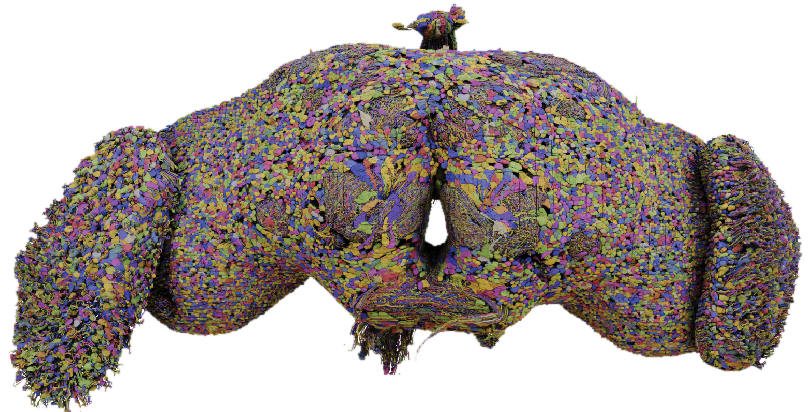
A 3D rendering of a fruit fly's brain, wide and low, packed with neurons in pink, yellow, blue and green, with an optic lobe at each end.
All 139,255 neurons in the brain of an adult fruit fly, each in its own colour, as the FlyWire Consortium reconstructed them. The whole brain is smaller than a poppy seed. Dorkenwald et al., Nature, 2024, Fig. 1a. CC BY 4.0. Background made transparent and labels set in this page's type.

Adult fruit fly brainFlyWire, 2024

Neurons
139,255
Synapses
50 million
Cell types
8,453
Regions
78

CORTEX, as it shipsOne brain per role

Neurons
1,488
Synapses
5,653
Brains
35
Regions per brain
9

Why map it

What a connectome is for.

FlyWire, the Princeton-led team that mapped the fly, says it in one line. Swap the fly for a business and it still holds.

“Having a full brain connectome of Drosophila is a valuable resource for neuroscientists.”

FlyWire, Princeton University

Having a full brain connectome of your business is a valuable resource for business owners and managers.

What FlyWire says a fly connectome is forWhat yours is for

  1. “Identify and map the different types of neurons in the brain.”

    Know what the business knows.

    Every procedure, rule, figure and pattern has its own place, and says where it came from.

  2. “Study how neurons are connected to each other and how these connections enable information processing and learning.”

    See how work moves.

    Who hands a question to whom, and what each answer rests on, can be followed from one end to the other.

  3. “Predict how the brain responds to different stimuli, such as lights, sounds, or smells.”

    Know where a question will go.

    A question about margin, stock or ad spend has an owner before anyone asks it, because the route is written into the map.

Method

Mapped the same way, step by step.

FlyWire brought together more than 146 labs to map the fly. Each step of their method has a counterpart in how a CORTEX brain is built.

  1. 01Take in the whole thing

    The fly brainA team at HHMI's Janelia Research Campus imaged a complete adult fly brain under an electron microscope: 21 million images.

    Your businessThe whole business, not one team. Every role gets a brain of its own: as CORTEX ships, a CEO, 8 department heads and 26 specialists.

  2. 02Trace every cell

    The fly brainAn AI model built in Sebastian Seung's lab at Princeton traced each neuron through the images, as a 3D shape.

    Your businessWhat the business knows is broken into single pieces: a procedure, a rule, a pattern, a contact. Each piece is a neuron.

  3. 03Find the connections

    The fly brainThe synapses between the neurons were detected automatically: about 50 million of them.

    Your businessEach piece is connected to the pieces it depends on, and every connection can be checked: 5,653 of them as CORTEX ships.

  4. 04Proofread it by hand

    The fly brainScientists, professional tracers and citizen scientists checked the machine's work: 33 person-years since 2022. Without the AI, Seung reckons, it would have taken almost 50,000.

    Your businessPeople check the agents. Agents find, people fix, and each brain learns from what it is told.

  5. 05Name every cell

    The fly brainEvery neuron was classified, from which way its signals flow down to its cell type: 8,453 cell types in all.

    Your businessEvery piece is classified the way FlyWire classifies a neuron: by region, then by type.

  6. 06Open it up

    The fly brainAnyone can explore the map in FlyWire Codex. By September 2024 it had been searched more than 1.5 million times.

    Your businessPick a question on the CORTEX map and watch it travel from the CEO to the specialists who can answer it. Open the map

Wiring

Their diagrams, and ours.

Three figures from the paper that published the fly connectome, each beside the same view of CORTEX as it ships, drawn from its own neurons and synapses.

In, inside, out.

FlyWire sorts every neuron by the way its signals flow: in from the senses, around inside the brain, or out to the body. The regions of a CORTEX brain sort the same way. Intake comes in at the top. Memory, command, alerts and calibration work inside. At the bottom are the procedures it acts with and the tools it can reach.
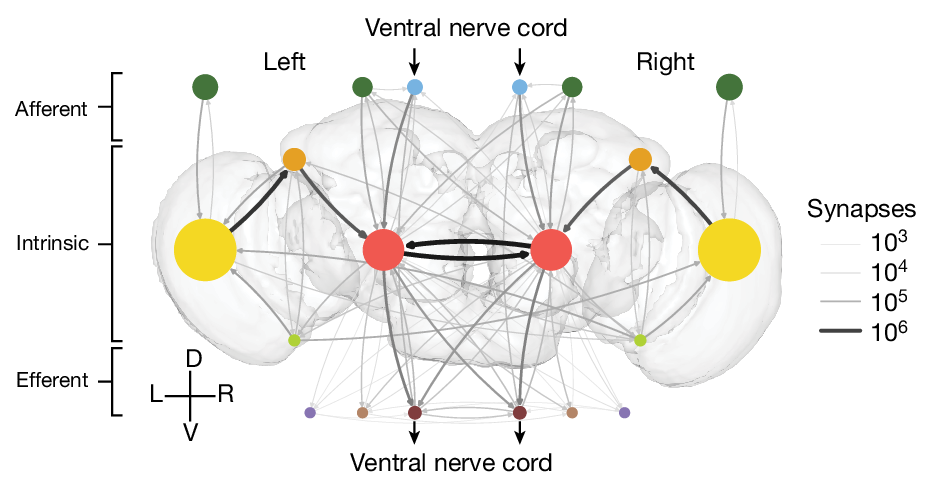
FlyWire's diagram of the fly brain's neuron groups as circles over a pale brain: sensory and ascending neurons at the top, optic and central neurons in the middle, descending, motor and endocrine neurons at the bottom, joined by lines weighted by synapses.
The flyThe fly's neurons in groups, joined by the synapses between them. In: sensory and ascending neurons. Inside: optic, central and visual projection neurons. Out: descending, motor and endocrine neurons.Dorkenwald et al., Nature, 2024, Fig. 2b. CC BY 4.0. Cropped.
ininsideout Questions and signals People and systems SEZCCAMGCXMBCoreBGCBSkillsMCBS Synapses 10100500
CORTEXThe regions of all 35 CORTEX brains, pooled. Circle area is the number of neurons in a region; a line joins two regions whose neurons connect, heavier for more synapses.

Which region talks to which.

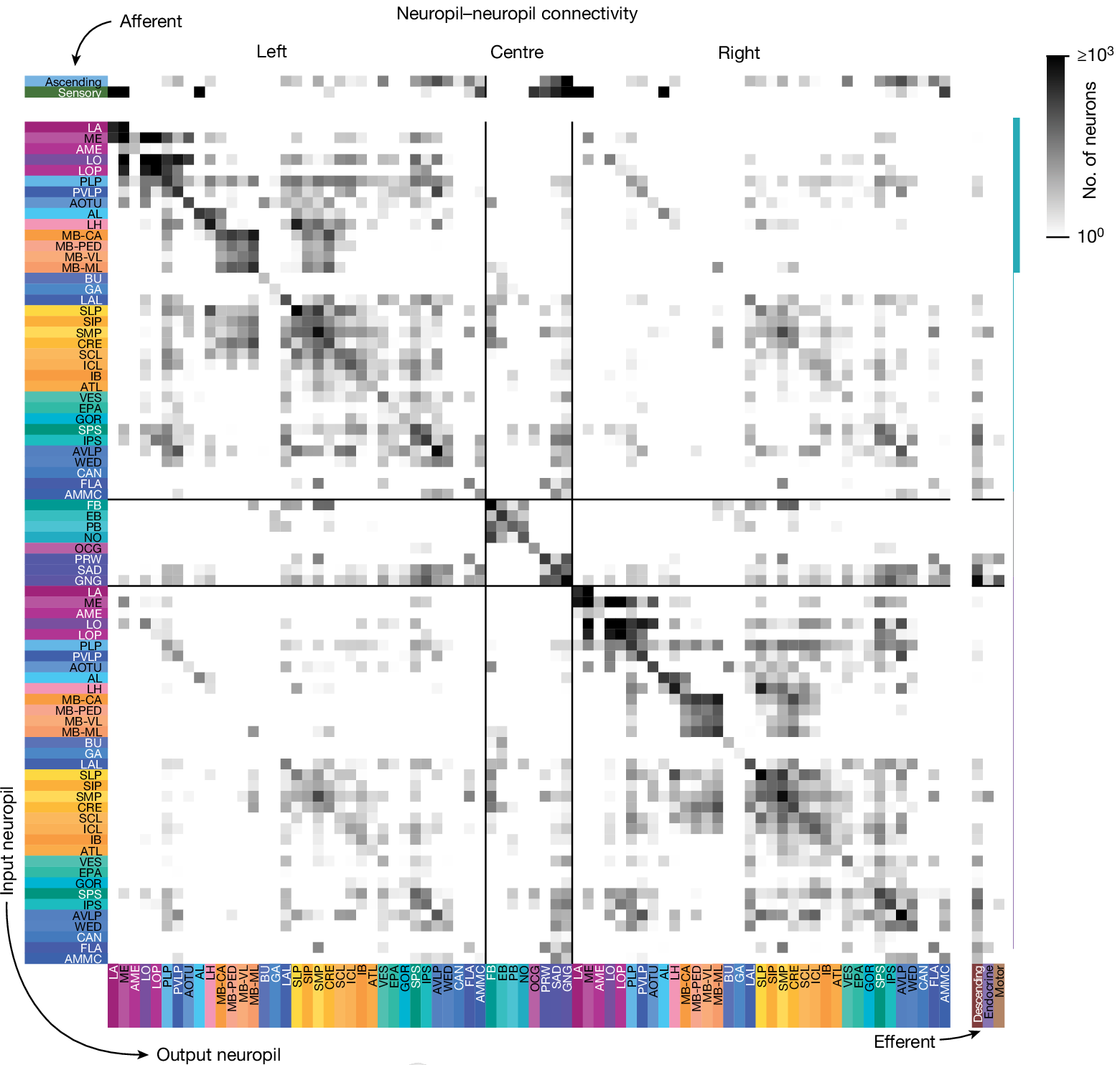
FlyWire counts the neurons running from each region of the fly's brain to every other. Ours counts the synapses between each pair of regions. A third of them stay inside one region. Procedures do most of the talking between regions: to the body schema, the core and memory.

FlyWire's neuropil-to-neuropil matrix: a large grid of grey squares, darker where more neurons run from one region of the fly brain to another, with coloured region labels down the side and along the bottom.
The flyNeuropil to neuropil: how many neurons run from each region of the fly's brain, left, centre and right, to each of the others.Dorkenwald et al., Nature, 2024, Fig. 4a. CC BY 4.0. Cropped.
Synapses between each pair of regions, over all 35 CORTEX brains. A synapse inside one region is counted on the diagonal.
SEZMBCXMCAMGCBCCBGBSCoreSkills
SEZ 029229361429523340
MB 295943839431725692222060
CX 223806263152010580
MC 9339462658115961271225184935
AMG 631611524151350520
CB 1473964352261630
CC 29251512715220799701
BG 56920122132749491101
BS 2322210518506199493973101
Core 3420658493526370110310892
Skills 00050011120
CORTEXSynapses between each pair of regions, over all 35 brains: 5,653 in all. The diagonal counts the synapses inside one region.

How far a signal spreads.

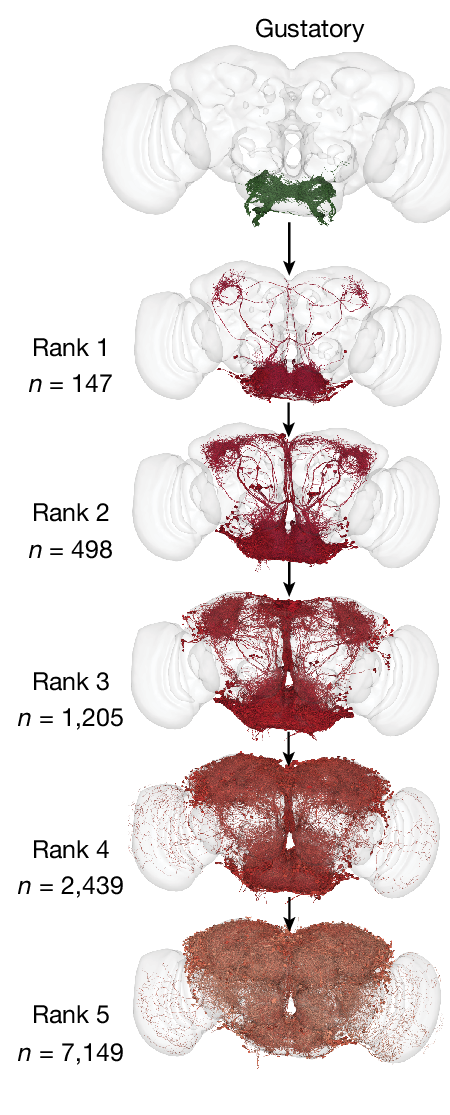
In the fly, a taste reaches 147 neurons in one step and 7,149 by the fifth. A CORTEX question goes the other way, on purpose. Each agent uses only the part of its brain the question needs. The margin question passes through 19 of the 1,488 neurons.

FlyWire's taste cascade: six fly brains stacked top to bottom, the first showing the taste neurons in green, then more of each brain filled in red at every rank, from 147 neurons at rank 1 to 7,149 at rank 5.
The flyInformation flow from the fly's taste neurons: the neurons reached at each rank, from 147 at the first to 7,149 at the fifth.Dorkenwald et al., Nature, 2024, Fig. 6b. CC BY 4.0. Cropped.

QuestionWhat margin are we making this quarter?

  1. Step 1

    CEO5 of 37 neurons
  2. Step 2

    CFO5 of 57 neurons
  3. Step 3

    Accounts Specialist4 of 326 neurons
    Pricing & Margins Analyst5 of 29 neurons
Every sample question, and how far it travels through the 1,488 neurons
QuestionBrainsNeurons
What margin are we making this quarter?419
Which deals have gone quiet?313
Can we cover next month's orders from stock?421
Is anything about to break?420
Where is the ad budget working?421
Can we take on 40 percent more orders?527
CORTEXOne question's route, step by step. The neurons it passes through are lit; the rest of each brain stays dim.

Names

Every region is named after part of a brain.

Three share their initials with regions of the fly's brain. The other six come from the human brain, and on the map each one is drawn where its namesake sits.

RegionNamed afterIn a CORTEX brain
SEZSubesophageal zone The flyThe subesophageal zone, where taste and signals from the body arrive. Intake: messages, platform data and signals from other agents.
MBMemory body The flyThe mushroom body, where a fly learns and remembers. What it knows: reference, patterns and calibrations.
CXCommand complex The flyThe central complex, which steers where the fly goes. Decisions and live directives.
MCMotor cortex A personThe motor cortex, which sends out movement. How it acts: procedures and playbooks.
AMGAmygdala A personThe amygdala, which raises the alarm. Alerts: risks, contradictions and escalations.
CBCerebellum A personThe cerebellum, which keeps movement in time. Rhythm: routines and recurring checks.
CCCorpus callosum A personThe corpus callosum, the bridge between the brain's two halves. Connections to other brains, in and out.
BGBasal ganglia A personThe basal ganglia, which learn from reward and feedback. Calibration: feedback from its person, and trust.
BSBody schema A personThe body schema, the brain's working map of its own body. Its body: the tools, databases and channels it can reach.

Next

In 2026 the map reached the body.

In September 2026, HHMI Janelia, Google Research and collaborators in Cambridge published the connectome of a male fruit fly's whole central nervous system: the brain, and the nerve cord that works like its spinal cord.

Neurons
166,700
Synaptic connections
125 million
Neuron types
11,710

By number of neurons it is the largest brain map yet, and it lets scientists follow a signal from the senses all the way to the muscles.

A CORTEX brain has a body too. Its body schema lists the tools, databases and channels it can reach, and the specialists are where the brains meet the systems the business runs on.

Your business has a connectome already. It just isn't written down.

Every business runs on connections: who knows what, who asks whom, which figure comes from which system. CORTEX writes them down, one brain per role, wired to the tools you already use. The first step is a few questions about how your business runs, then a call to map where it fits.

Get startedteam@aethons.ai

Sources

  1. Dorkenwald, S. et al. Neuronal wiring diagram of an adult brain. Nature 634, 124–138 (2024).139,255 neurons, 50 million synapses, the flow of signals, the neuropil matrix and the taste cascade, and the four figures.
  2. Schlegel, P. et al. Whole-brain annotation and multi-connectome cell typing of Drosophila. Nature 634, 139–152 (2024).8,453 cell types.
  3. Berg, S. et al. Sexual dimorphism in the complete Drosophila male central nervous system connectome. Cell 189, 5504–5526 (2026).The male central nervous system: 166,700 neurons and 11,710 neuron types.
  4. Januszewski, M. and Jain, V. A connectomics milestone: mapping the complete male fruit fly brain. Google Research, 3 September 2026.125 million synaptic connections, and the largest brain map by number of neurons.
  5. FlyWire, Princeton University. About FlyWire.The quotation, and the three uses of a connectome.
  6. FlyWire, Princeton University. FlyWire media kit.21 million images, 33 person-years of proofreading, more than 146 labs, 78 regions, 1.5 million searches, and the poppy seed.

The four figures of the fly brain are from Dorkenwald et al. (2024) and are used under a Creative Commons Attribution 4.0 licence. Each caption says what was changed. Aethons is not connected with FlyWire, Princeton University, HHMI Janelia, the University of Cambridge or Google, and none of them endorses CORTEX.